

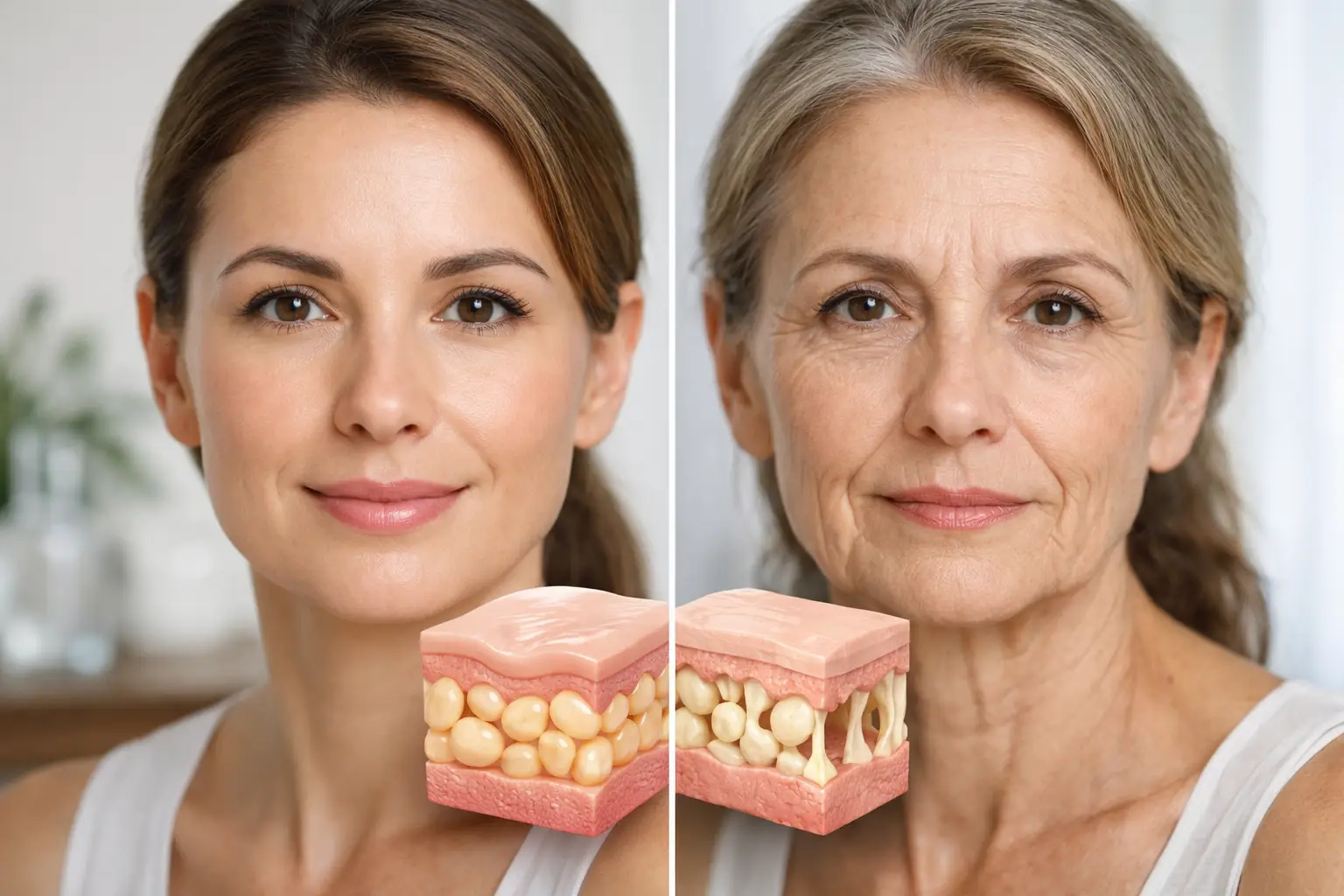
Learn what causes facial volume loss, from collagen decline and fat shift to lifestyle and sun damage, plus how to restore natural-looking fullness.
You usually notice facial volume loss before you can name it. The cheeks look a little flatter in certain lighting, under-eye hollows seem deeper after a long week, or the jawline appears less defined than it did a year ago. If you have been wondering what causes facial volume loss, the answer is rarely just age. It is a layered process involving skin, fat, bone, muscle movement, and daily habits that quietly shape the face over time.
Understanding those layers matters because volume loss is not the same as surface dryness or fine lines. It changes facial structure. That is why a face can look tired, drawn, or older even when the skin itself is well cared for. Once you know what is actually changing, treatment decisions become far more precise and results tend to look more natural.
What causes facial volume loss?
Facial volume loss happens when the tissues that give the face youthful support and softness begin to decline, shift, or thin out. In practical terms, that includes collagen and elastin depletion in the skin, loss or descent of facial fat pads, gradual bone resorption, and changes in hydration and skin quality.
These processes do not affect every face the same way. One person loses volume first in the cheeks, another in the temples, another around the mouth. Genetics play a role, but lifestyle and environmental exposure often accelerate the timeline.
The biggest structural reasons volume disappears
Collagen and elastin decline
Collagen is one of the main support structures that keeps skin firm and resilient. Elastin helps skin spring back into place. Starting in early adulthood, production of both begins to slow. Over time, skin becomes thinner and less able to hold its shape against gravity and facial movement.
This does not create volume loss on its own, but it removes support from the tissues underneath. The face can begin to look less lifted, especially across the mid-face, lower cheeks, and around the mouth.
Facial fat pads shrink and shift
A youthful face is not simply tighter. It is also strategically full. Distinct fat compartments in the cheeks, temples, under-eye area, and around the mouth create soft transitions and balanced contours. As these fat pads shrink or move downward with age, the face can look flatter in some areas and heavier in others.
This is why someone may notice hollowing under the eyes and temples while also feeling that the lower face looks fuller or less defined. It is not always weight gain. Often, it is redistribution.
Bone resorption changes the framework
One of the least discussed answers to what causes facial volume loss is bone remodeling. With age, the facial skeleton gradually changes. The eye sockets can widen, the jawline can lose definition, and support around the cheeks and mouth can recede.
When the bony foundation changes, the soft tissue above it has less support. That contributes to deeper folds, a more sunken appearance, and a less sculpted profile. This is one reason volume restoration often requires a full-face approach rather than treating a single line in isolation.
Lifestyle factors that speed up facial volume loss
Sun exposure
UV damage is one of the fastest ways to break down collagen. In a climate with strong year-round sun, this matters even more. Repeated exposure weakens the skin’s support network and accelerates thinning, laxity, and uneven texture.
A person who spends years in the sun without daily protection may see facial aging sooner and more dramatically than someone with similar genetics who protects their skin consistently.
Smoking and vaping
Smoking reduces blood flow, increases oxidative stress, and damages collagen. It also contributes to repetitive facial movements that deepen lines around the mouth. Vaping may avoid some of the combustion-related effects of cigarettes, but it does not support healthy skin aging.
The result is often a face that appears more hollow, less vibrant, and less elastic than expected for that person’s age.
Rapid weight loss
Weight loss can be excellent for overall health, but when it happens quickly, the face often shows it first. Fat in the face is part of what gives a rested, youthful look. If volume drops faster than skin can adapt, hollowing becomes more visible, especially in the cheeks and temples.
This is not a reason to avoid healthy change. It simply means facial aging may need to be addressed differently after major body transformation.
Stress, poor sleep, and dehydration
These factors do not directly remove bone or deep fat pads, but they can make volume loss look worse. Chronic stress raises inflammatory signals, sleep deprivation affects recovery, and dehydration leaves skin less plump and reflective.
Sometimes patients think they have suddenly aged, when in reality fatigue is amplifying structural changes that were already underway.
Why facial volume loss can happen earlier than expected
Many people associate volume loss with their 50s or 60s, but it often starts earlier. In the late 20s and 30s, collagen production begins to decline. Subtle changes in the under-eye area, temples, and cheeks can appear long before deep wrinkles set in.
This is especially true for people with naturally lean faces, high metabolism, strong sun exposure, or family patterns of early facial hollowing. The face may still look youthful overall, but photos start revealing shadows, flattening, or a tired expression that makeup cannot fully correct.
That early stage is often the best time for prevention-minded treatment. Small, well-planned interventions usually look more refined than waiting for more advanced loss and trying to reverse everything at once.
What causes facial volume loss in specific areas?
Cheeks
The cheeks lose volume due to fat pad descent, collagen decline, and changes in bone support. This can make the mid-face appear flatter and deepen the nasolabial folds.
Under-eyes
Under-eye hollows are often caused by a mix of genetics, thinning skin, volume loss in the mid-face, and changes around the orbital bone. Not every under-eye concern is true volume loss, which is why careful assessment matters.
Temples
Temple hollowing is common but often overlooked. It can make the upper face appear more skeletal and less balanced. Age-related fat loss is a major reason here.
Jawline and lower face
Volume loss in the jawline is usually less about losing fullness and more about losing structural support. Skin laxity, bone changes, and descent from the mid-face all contribute to a softer, heavier-looking lower face.
Can skincare fix facial volume loss?
Skincare helps, but its role has limits. Medical-grade skincare can improve hydration, texture, pigment, and some aspects of collagen support. That makes the face look fresher and more polished. It can also help slow visible aging.
What it cannot do is replace lost fat, rebuild significant bone support, or reposition descended tissue. That is where many people become frustrated. They invest in excellent products yet still feel they look tired or hollow. The issue is not always the skin surface. It is often the architecture underneath.
How facial volume loss is treated effectively
The right treatment depends on what has actually changed. If the issue is early collagen depletion, biostimulatory treatments may be the most elegant option. If there is deeper structural loss, dermal fillers can restore support and contour with more immediate definition. Skin tightening technologies may be useful when laxity is part of the picture. Often, the best result comes from combining approaches rather than relying on one treatment alone.
For patients who want natural-looking enhancement, the goal is not to make the face look larger or overfilled. It is to restore harmony. That may mean soft cheek support, temple balancing, improved skin quality, or collagen stimulation over time. At a medically led aesthetic clinic such as Fit4You Polyclinic, a personalized plan is what separates refined rejuvenation from generic correction.
It is also worth saying that not every hollow area should be filled. In some cases, addressing skin laxity, hydration, or overall facial balance creates a better result than adding volume to one spot. This is where expertise matters most.
Prevention and maintenance matter more than most people think
You cannot stop aging, but you can influence how gracefully the face changes. Daily sunscreen, strong skincare, stable weight management, good sleep, and early professional guidance all help preserve facial support longer.
For patients already seeing changes, maintenance usually works better than correction after years of delay. Smaller treatments spaced over time tend to keep the face looking refreshed without obvious intervention. That approach also allows results to evolve naturally with your features, lifestyle, and goals.
Facial volume loss is not a flaw to chase obsessively. It is a normal biological process, but one that can be managed beautifully when you understand what is driving it. The most flattering results come from respecting the face, treating the right layer, and choosing a plan that restores confidence as much as contour.
Interested in this treatment?
Book a free consultation with our specialists at Fit4You Polyclinic Dubai.
Book Free Consultation