

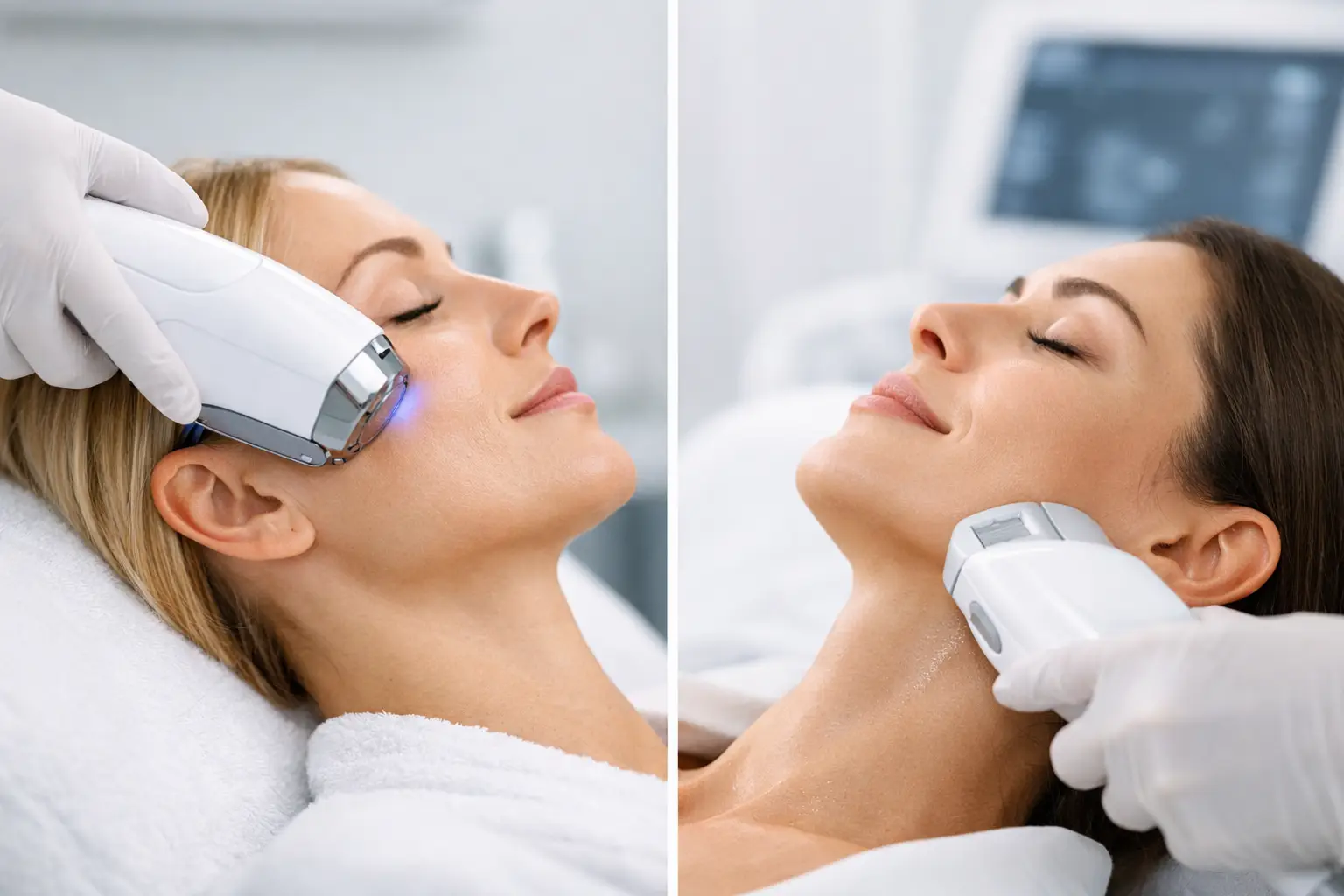
Compare sofwave vs ultherapy results for lifting, firmness, comfort, and downtime. Learn which treatment may better match your skin goals.
A treatment can sound perfect on paper, then feel very different once real-life factors enter the picture - comfort, downtime, timing, and how much lift you actually notice in the mirror. That is why sofwave vs ultherapy results is such a common comparison for patients who want firmer, tighter skin without surgery.
Both treatments are designed to stimulate collagen and improve laxity, but they do not feel the same, they do not target tissue in the same way, and they do not always suit the same patient. If your goal is a refined, natural-looking lift with little interruption to your schedule, the better option often comes down to where your skin is now and how dramatic you want the change to be.
Sofwave vs Ultherapy results at a glance
At a high level, both Sofwave and Ultherapy are non-surgical skin tightening treatments that use ultrasound energy. Their shared purpose is collagen renewal. Over time, that collagen remodeling can improve skin firmness, soften early sagging, and create a more lifted appearance in areas such as the brows, jawline, cheeks, neck, and under the chin.
The difference lies in how the energy is delivered and what that usually means for patient experience and visible outcome. Sofwave uses synchronized ultrasound technology to heat the mid-dermis at a controlled depth, encouraging collagen and elastin production while protecting the upper layers of skin with integrated cooling. Ultherapy uses focused ultrasound to target deeper structural layers, including the foundational tissue often discussed in surgical lifting conversations.
That distinction matters because it shapes expectations. Sofwave is often favored for improving mild to moderate skin laxity with a smoother treatment experience. Ultherapy is often chosen when a patient wants to address deeper laxity and is willing to accept a more intense treatment in pursuit of that goal.
How the results actually look
When patients ask about results, they are rarely asking only about collagen biology. They want to know what changes they will notice in photos, during makeup application, and when they catch their reflection in strong daylight.
With Sofwave, results often look polished rather than obvious. Skin may appear firmer, slightly lifted, and more refined in texture over the following weeks and months. The improvement can be especially appealing for patients who want to look fresher without looking treated. Brow elevation, a cleaner jawline, and a tighter look around the lower face are common goals.
Ultherapy results can also be natural-looking, but the treatment is more commonly associated with structural tightening in deeper tissue. For some patients, that can translate into more meaningful lifting in the lower face or under the chin. The trade-off is that the path there may feel less comfortable and require more patience.
Neither treatment delivers the instant, dramatic repositioning of a surgical facelift. Both rely on your body building new collagen. That means the best outcome is gradual. If someone promises a surgical-level transformation from one ultrasound session, that expectation needs to be adjusted.
Which treatment shows results faster?
In the Sofwave vs Ultherapy results discussion, timing is one of the biggest decision points.
Sofwave patients often notice an early improvement in skin quality and firmness within several weeks, with fuller results developing over about 12 weeks. Some continue to see refinement after that as collagen remodeling progresses. The appeal here is that the treatment fits well for patients planning around work, travel, events, or social commitments.
Ultherapy can take longer to fully declare itself. Many patients are told to expect progressive improvement over two to three months, with continued changes for up to six months. That longer runway is not necessarily a negative, but it does matter if you are hoping to look better by a specific date.
If you want a collagen treatment before a wedding season, business event, or vacation, treatment timing should be part of the consultation, not an afterthought.
Comfort and downtime matter more than most people expect
Results do not exist in a vacuum. The treatment experience often shapes whether a patient feels the choice was worthwhile.
Sofwave is widely considered the more comfortable option. Its integrated cooling helps protect the skin surface while making the procedure more tolerable. Most patients can return to normal activity quickly, and visible post-treatment effects are usually mild, such as temporary redness or slight swelling.
Ultherapy has a reputation for being more intense during treatment because it reaches deeper tissue levels. Some patients tolerate it well, especially with supportive comfort measures, but others find it noticeably uncomfortable. Tenderness, swelling, or sensitivity afterward can also be more pronounced.
For busy professionals and social patients who want high-performance treatments without a recovery narrative, this difference can be decisive. A beautiful result is still part of a lifestyle, and the best treatment is one you can comfortably fit into your real calendar.
Sofwave vs Ultherapy results by concern
The best comparison is not brand versus brand. It is concern versus technology.
Mild skin laxity and early aging
If the skin is just starting to lose firmness, Sofwave is often an excellent fit. Patients in their late 20s, 30s, and early 40s who want prevention plus visible improvement often appreciate the refreshed, elegant finish it can provide. It suits the patient who says, “I look a little tired, a little loose, but not dramatically aged.”
Brow lift and facial refinement
Both treatments can help, but Sofwave is often selected for subtle yet meaningful lifting and tightening in the upper face and along the jawline. The outcome tends to look soft, fresh, and camera-friendly.
Moderate laxity and deeper tissue concerns
Ultherapy may have an advantage for patients with more established sagging, particularly when deeper support structures need attention. This does not mean it is always better. It means it may be more appropriate in specific cases.
Neck and under-chin definition
Both are used in these areas. The better option depends on whether the issue is early crepiness and mild looseness, or more advanced laxity that may benefit from deeper ultrasound targeting.
Why age is not the real deciding factor
Patients often assume younger means Sofwave and older means Ultherapy. In practice, skin quality, degree of laxity, facial anatomy, and expectations matter far more than age alone.
A 35-year-old with significant weight-loss-related laxity may need a different plan than a 48-year-old with excellent skin quality and only mild sagging. Likewise, someone with very thin skin, strong collagen reserves, or a preference for minimal discomfort may lean in a different direction than someone who is comfortable with a more aggressive treatment approach.
This is where medically guided assessment matters. The same device can produce a beautiful result for one patient and a disappointing one for another if the indication is wrong.
Can one treatment replace the other?
Not really. Sofwave and Ultherapy overlap, but they are not interchangeable in every case.
Sofwave is not simply “Ultherapy but easier,” and Ultherapy is not automatically “stronger and therefore better.” Each device has a profile. Sofwave often wins on patient comfort, convenience, and elegant collagen-based refinement. Ultherapy may appeal when deeper structural tightening is the priority and the patient accepts a more intense treatment experience.
In premium aesthetic care, the right answer is rarely the most aggressive treatment. It is the one that aligns with your anatomy, your tolerance, and your definition of success.
When combination planning makes more sense
For some patients, ultrasound tightening should not be the entire strategy. If laxity is mixed with volume loss, skin texture changes, pigmentation, or muscle-related lines, one device may only address part of the picture.
That is why advanced clinics often create treatment plans rather than pushing a single hero procedure. A patient may benefit from Sofwave or Ultherapy for tightening, then pair that with injectables, collagen stimulators, skin rejuvenation, or laser-based treatments depending on the concern. At Fit4You Polyclinic, that personalized approach is central to achieving results that look balanced, not overdone.
So which one is better?
If your priorities are comfort, minimal downtime, and a polished tightening effect for mild to moderate laxity, Sofwave is often the more appealing choice. If your concern is deeper tissue laxity and you are willing to trade some comfort for a treatment designed to reach those lower layers, Ultherapy may be worth considering.
The better question is not which treatment is best in general. It is which treatment is best for your face, your skin quality, and your timeline. In aesthetics, precision usually outperforms hype. The most satisfying result is the one that fits you so well that other people only notice you look rested, lifted, and exceptionally well cared for.
If you are choosing between the two, look beyond the device name and focus on the treatment plan behind it. That is where beautiful results usually begin.
Interested in this treatment?
Book a free consultation with our specialists at Fit4You Polyclinic Dubai.
Book Free Consultation