

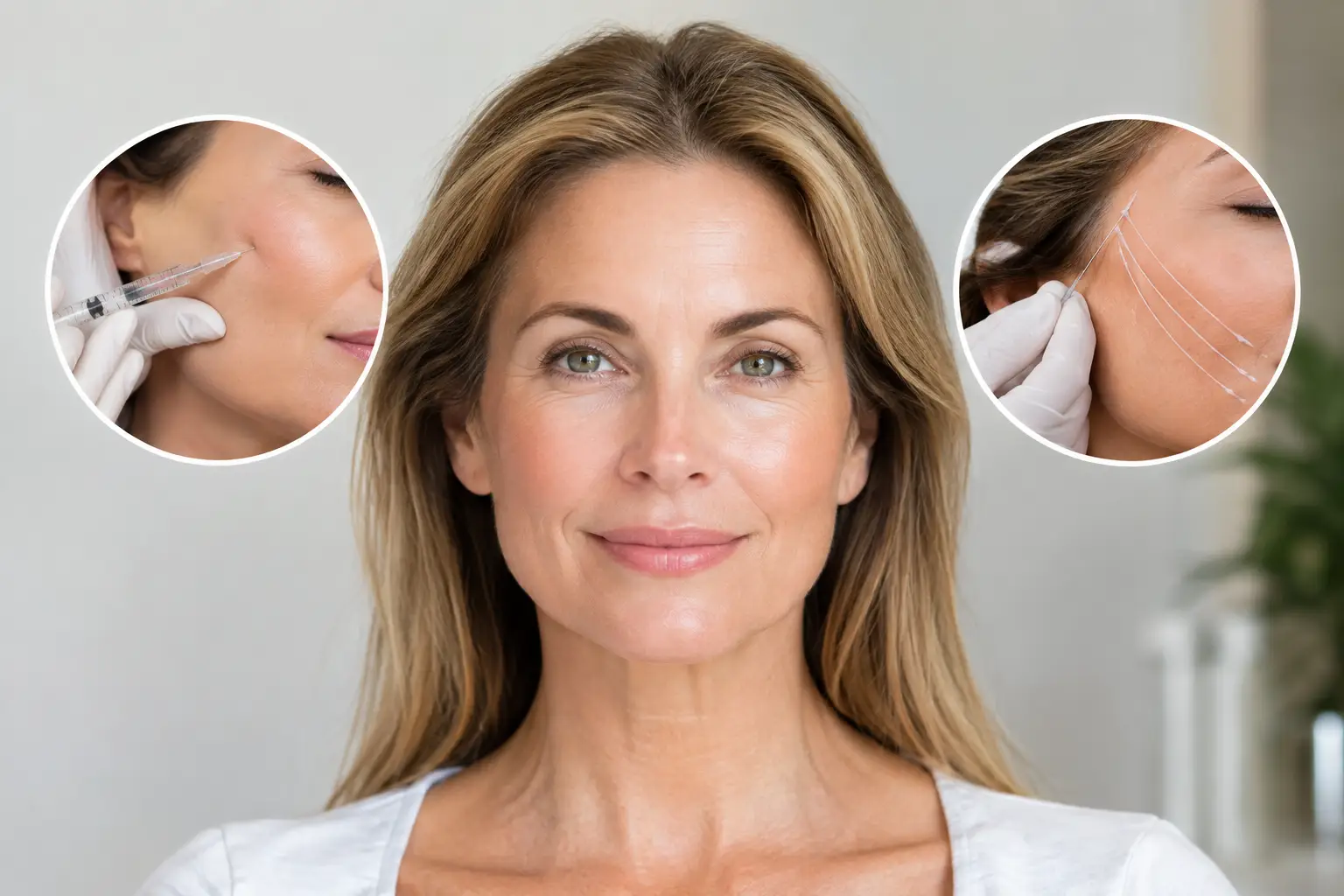
Compare Sculptra versus thread lift for volume, lift, longevity, downtime, and natural-looking facial rejuvenation with expert insight for your next step.
A face can look tired for two very different reasons: it may have lost the soft volume that once supported the cheeks and temples, or the skin and underlying tissues may have begun to descend. That distinction is at the center of the Sculptra versus thread lift decision. Both treatments can refresh facial contours without surgery, but they work in fundamentally different ways - and choosing the right one matters more than choosing the latest trend.
For clients who want an elegant, natural-looking result, the question is not simply which procedure creates the most dramatic change. It is which approach respects your facial structure, skin quality, lifestyle, and timeline for results.
Sculptra Versus Thread Lift: The Core Difference
Sculptra is a collagen-stimulating injectable treatment. Rather than acting like a traditional filler that immediately adds gel-based volume, Sculptra uses poly-L-lactic acid to encourage the body to gradually produce new collagen. Over a series of treatments, it can restore structural support and improve the appearance of hollow cheeks, temples, jawline softness, and overall facial volume loss.
A thread lift uses absorbable sutures placed beneath the skin to reposition selected tissues. Certain threads have small cones or barbs that provide mechanical support, allowing an experienced practitioner to create a visible lifting effect in areas such as the cheeks, jawline, brows, or neck. The threads also stimulate some collagen as they dissolve, though their primary role is physical repositioning.
Put simply, Sculptra rebuilds support gradually from within. Threads reposition tissue more immediately. One is not automatically better than the other. The ideal choice depends on whether volume loss, laxity, or a combination of both is driving the change you see in the mirror.
What Results Can You Expect From Sculptra?
Sculptra is especially valued for its subtle, progressive approach to facial rejuvenation. Results do not appear overnight. Collagen production takes time, and most clients begin noticing a fresher, more supported look over several weeks, with continued improvement over the following months.
This gradual timeline can be a major advantage for people who prefer discretion. Colleagues may notice that you look rested, healthier, or less drawn without being able to identify exactly what changed. The goal is not a puffy or overfilled appearance. It is a return to a more balanced version of your own facial architecture.
Sculptra is often well suited to clients with diffuse volume loss rather than one small area that needs correction. For example, a person whose cheeks, temples, and lower face have all become less supported may benefit more from collagen stimulation than from placing traditional filler into multiple isolated points.
A treatment plan usually involves more than one session, spaced according to the provider’s clinical assessment. Longevity varies by individual, but results may last two years or longer once collagen has developed and the treatment course is complete. Maintenance can help preserve the result over time.
When Sculptra May Be the Better Fit
Sculptra can be an excellent choice if your main concern is facial deflation, hollowing, or a gradual loss of firmness. It is also appealing for those who are comfortable waiting for refinement rather than seeking an instant lift before an imminent event.
It may be less suitable when the primary concern is pronounced skin laxity or tissue descent. Collagen stimulation can improve support and skin quality, but it cannot physically lift significantly sagging tissue in the same way a thread-based technique can.
What Results Can You Expect From a Thread Lift?
A thread lift is designed for clients who want a more immediate contour change without undergoing surgical facelift procedures. Following treatment, the face may appear lifted and more defined, particularly through the midface, jawline, or lower cheek area. Swelling can initially make the result look more pronounced, so the final appearance becomes clearer as the area settles.
The procedure generally involves local anesthetic and strategically placed absorbable threads. Precision is essential. Threads need to follow the right anatomical plane, with an approach tailored to the thickness of the skin, degree of laxity, facial proportions, and desired vector of lift.
Thread lifts can create beautiful results in appropriately selected patients, especially when laxity is mild to moderate and the skin still has reasonable elasticity. They are not a substitute for a surgical facelift when there is substantial excess skin or advanced tissue descent. Setting that expectation early protects both safety and satisfaction.
Thread lift results are often visible sooner than Sculptra results, but they are typically shorter-lived. Many clients enjoy results for roughly one to two years, although this can vary based on the thread type, metabolism, skin condition, and lifestyle. The collagen-stimulating effect may continue beyond the period of mechanical lifting, but it should not be mistaken for permanent structural correction.
When a Thread Lift May Be the Better Fit
A thread lift may be appropriate if you can pinch mild looseness along the jawline, notice descent through the cheek area, or want a sharper contour with relatively little downtime. It can also suit someone preparing for a milestone event who wants improvement on a faster timeline, provided the procedure is planned well in advance to allow swelling and bruising to resolve.
Threads may not be the best first choice for very thin skin, significant volume depletion, or heavily sagging tissue. In some cases, lifting a face that lacks underlying volume can create a pulled or less harmonious appearance. Restoring support first may produce a more refined result.
Downtime, Comfort, and Practical Considerations
Both treatments are non-surgical, but neither should be treated as casual. Sculptra injections can cause temporary swelling, tenderness, bruising, or small areas of firmness. Your provider may recommend massage after treatment, depending on the product placement and protocol. Most people return to normal routines quickly, though strenuous exercise and excessive heat may need to wait briefly.
Thread lifts usually involve more recovery considerations. Swelling, bruising, tenderness, tightness, and temporary asymmetry can occur. Clients may be advised to sleep on their back, avoid wide mouth movements, delay vigorous workouts, and be gentle with facial massage for a period after treatment. The exact aftercare depends on the treatment area and thread technique.
The trade-off is straightforward: Sculptra generally offers a gentler, slower evolution, while threads can offer earlier lifting with a more involved recovery window. Neither should be selected based on downtime alone. An unsuitable treatment with a convenient recovery is still an unsuitable treatment.
Can Sculptra and Threads Be Combined?
For the right patient, yes. A thoughtful combination plan can address both the loss of facial support and the descent of tissue. Sculptra may be used to rebuild volume gradually, while threads can be considered for targeted lifting where needed.
Timing is highly individual. Some clients benefit from restoring volume before considering threads, while others may be candidates for carefully sequenced treatment. The order should be determined through an in-person assessment, not a standard package or social media trend.
At Fit4You Polyclinic, a personalized consultation focuses on the full facial picture: skin quality, bone structure, volume distribution, degree of laxity, medical history, and the level of change you want to see. This approach helps avoid overtreatment and keeps the outcome aligned with your features.
How to Choose Safely
The most successful results begin with an honest assessment. Ask your provider what is actually causing the change you see, where the treatment will be placed, how many sessions may be needed, and what a realistic outcome looks like for your anatomy. You should also discuss prior fillers, facial procedures, medical conditions, medications, and any history of autoimmune or inflammatory concerns.
Choose a medically qualified provider with detailed knowledge of facial anatomy and a conservative aesthetic eye. With Sculptra, correct dilution, placement, and technique are central to a smooth result. With threads, provider skill is equally critical because placement depth and directional planning affect both appearance and safety.
A beautiful result should not announce itself. Whether you choose collagen stimulation, targeted lifting, or a carefully staged combination, the right treatment plan should leave you looking like yourself - rested, supported, and confidently refined.
Interested in this treatment?
Book a free consultation with our specialists at Fit4You Polyclinic Dubai.
Book Free Consultation