

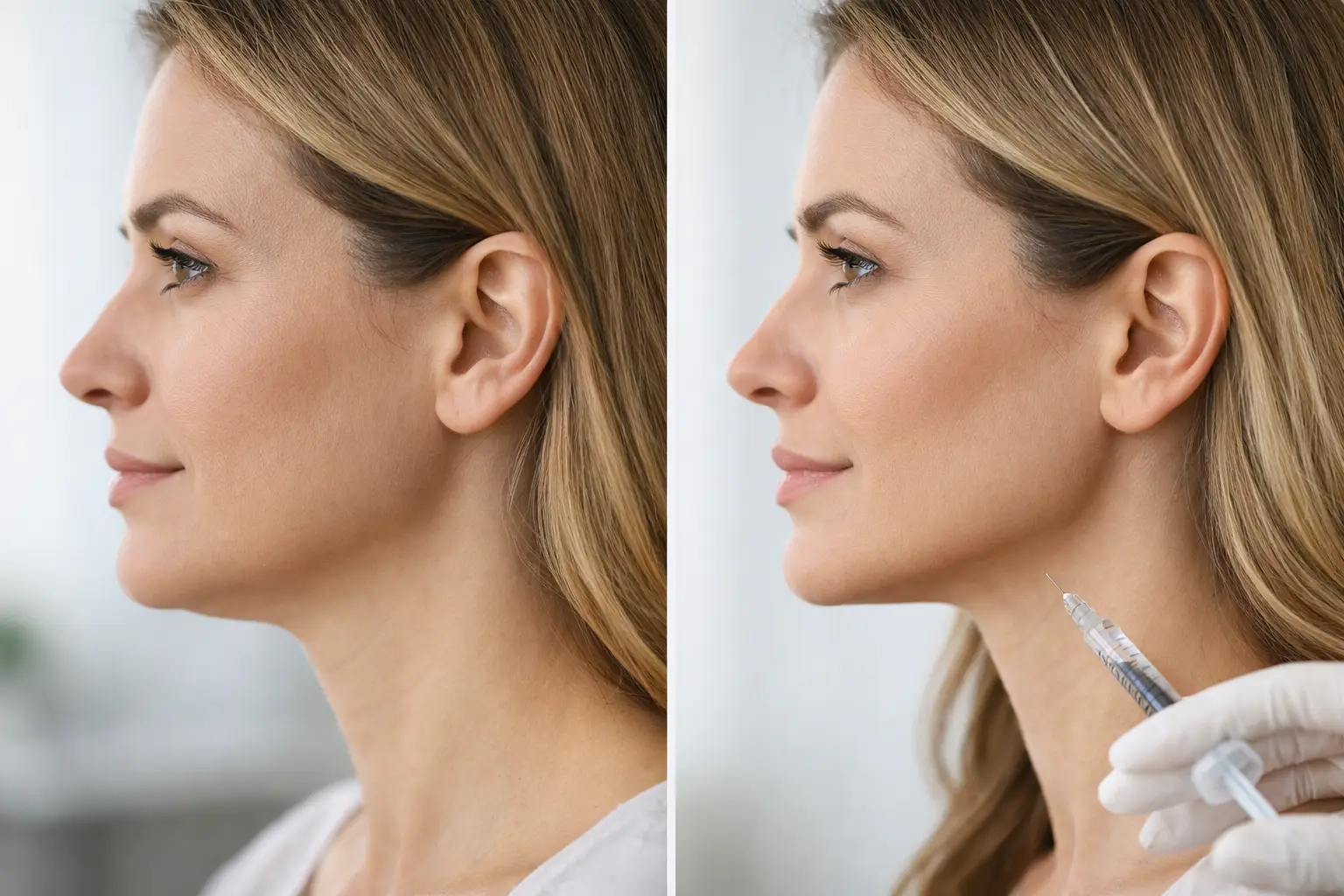
See what jawline filler before after results really look like, from shape and symmetry to swelling, longevity, cost, and candidacy.
A sharper jaw can change more than a profile photo. It can bring balance to the lower face, soften the look of jowling, and create definition that makeup, weight loss, and skin care cannot always deliver. That is why so many patients search for jawline filler before after results - not just to see dramatic photos, but to understand what is actually possible for their own face.
Jawline filler is not one fixed treatment. It is a customized injectable approach used to contour the mandibular angle, improve side-profile definition, support early sagging, and create a cleaner transition from the face to the neck. For some patients, the change is subtle and refined. For others, it is a stronger structural enhancement. The right outcome depends on anatomy, skin quality, age, and how much projection or sharpness is appropriate.
What jawline filler before after results usually show
The most convincing jawline filler before after transformations rarely look overfilled. They look more balanced. The jaw appears straighter, the chin and lower face feel more proportionate, and the area beneath the jawline often looks tighter even though filler is not the same as a skin-tightening treatment.
In younger patients, the goal is often sculpting. This may mean more visible angles, improved symmetry, or a stronger profile. In patients noticing early aging, the goal is often support. Filler can help disguise mild jowls, restore lost definition, and reduce the tired or softened appearance that happens when the lower face loses structure.
What before and after photos do not always show is how much technique matters. Product choice, injection depth, and placement along the angle of the jaw all affect the result. A beautiful outcome is not simply about adding volume. It is about creating shape without heaviness.
Who tends to be a good candidate
Jawline filler works best for adults who want more lower-face definition without surgery and who understand that injectable contouring has limits. It can be an excellent option for patients with a naturally softer jawline, minor asymmetry, or mild age-related volume loss. It can also suit men and women who want a more polished, structured appearance with little downtime.
There are, however, situations where filler is not the ideal answer. If skin laxity is significant, the issue may be less about missing volume and more about tissue descent. In that case, a provider may combine fillers with collagen-stimulating treatments, skin tightening, or other modalities rather than relying on filler alone. If excess fullness under the chin is caused by fat, contouring the jaw may help somewhat, but it will not replace a treatment designed to target submental fullness.
This is where consultation matters. A medically led plan should assess bone structure, facial proportions, movement, and skin quality before any product is chosen.
What changes immediately and what changes later
Most patients notice a visible change right after treatment. The jawline can look cleaner, straighter, and more sculpted as soon as the filler is placed. That immediate improvement is one reason this treatment remains so popular.
Still, the early result is not the final result. Mild swelling is common for several days and can slightly blur the shape at first. Small bruises may occur, especially in patients who bruise easily. Once swelling settles, the contour usually looks more refined and natural.
The most accurate before-after comparison is often around two weeks after treatment. At that point, the filler has settled, tenderness has eased, and the provider can better assess symmetry and whether any fine-tuning is needed. Patients expecting an event-ready jawline overnight should know that timing matters. It is smarter to schedule treatment at least two weeks before an important occasion.
The subtle truth behind dramatic photos
Some of the most striking jawline filler before after images are created by more than filler alone. Lighting, angle, posture, chin position, swelling stage, and even body weight can influence how defined the jaw appears in photos. This does not mean the treatment is ineffective. It means photos should be interpreted with a trained eye.
A trustworthy provider will show realistic outcomes and explain what was used to achieve them. In some cases, jawline enhancement is paired with chin filler to improve projection and create a stronger line from the side. In others, cheek support is part of the plan because midface structure can affect how the lower face is perceived. Treating the jaw in isolation is not always the most elegant solution.
For patients who want natural-looking refinement, this is good news. It means the best results are often tailored, not exaggerated.
How many syringes are usually needed
This is one of the first questions patients ask, and the answer is always personal. Jawline contouring often requires more product than lip enhancement or small facial touch-ups because the area is larger and the structure needs support. Some patients may see a meaningful improvement with a conservative amount, while others need several syringes for visible definition.
Men often request a broader, stronger jaw and may need more product to achieve that look. Women may prefer a cleaner line with softer elegance, which can sometimes be achieved with less. Facial width, existing bone structure, and skin thickness also affect the treatment plan.
An ethical injector will focus on proportion, not simply on volume. More filler does not automatically mean a better jawline. Past a certain point, it can make the lower face look bulky rather than defined.
How long results last
Jawline filler is not permanent, but it is not fleeting either. Depending on the product used, metabolism, and movement in the area, results often last from around 9 to 18 months. Some patients notice gradual softening earlier, while others maintain definition well beyond a year.
The jawline can hold filler relatively well because it is a more structural area than highly mobile zones such as the lips. That said, longevity depends on product selection and technique. Firmer fillers are often chosen for the jaw because they provide support and projection.
Maintenance is usually more efficient than starting over. Once the shape has been created, follow-up treatments may require less product than the initial session. For patients who value consistent definition, a long-term plan tends to deliver the most polished result.
Risks, side effects, and why expertise matters
Jawline filler is considered minimally invasive, but it is still a medical procedure. Common side effects include swelling, tenderness, redness, and bruising. These are usually temporary. Less common but more serious complications can occur with any filler treatment, which is why injector skill and anatomical knowledge are non-negotiable.
The jawline is a structural area that calls for precision. Product placed too superficially, too low, or in the wrong quantity can create puffiness, irregularity, or an unnatural contour. The goal should never be to chase a trend. It should be to enhance the face in a way that remains harmonious from every angle.
At a medically supervised aesthetic clinic such as Fit4You Polyclinic, the emphasis should be on individualized planning, premium products, and natural-looking enhancement rather than a one-size-fits-all template. That level of care tends to show in the after, even when the result is intentionally understated.
How to prepare for the best before-and-after outcome
The best results begin before the injection. Patients should come to their appointment with a clear sense of what they want to improve, but also with openness to professional guidance. A reference photo can help communicate preferences, though it should be treated as inspiration rather than a blueprint.
It is also wise to avoid scheduling filler immediately before travel, major social events, or high-pressure work commitments. While downtime is minimal, even mild swelling can make the first few days less camera-ready than expected. Following aftercare instructions closely helps reduce bruising and supports a smoother recovery.
Most importantly, choose a provider based on medical credibility and aesthetic judgment, not just price. Jawline filler is one of those treatments where the difference between average and exceptional often comes down to assessment, restraint, and technique.
Is jawline filler worth it?
For the right candidate, yes. It offers visible definition without surgery, can improve both front and side profile, and fits well into a modern aesthetic plan for patients who want refinement with limited downtime. But it is worth it only when expectations are realistic and the treatment plan is tailored to the face in front of the injector.
The most successful jawline filler treatments do not make you look like someone else. They make your features look cleaner, stronger, and more intentional. If you are studying jawline filler before after photos, the smartest next step is not to find the most dramatic transformation. It is to understand which result still looks believable up close, in motion, and in your own life.
A well-shaped jawline should not steal attention from the rest of your face. It should quietly elevate everything around it.
Interested in this treatment?
Book a free consultation with our specialists at Fit4You Polyclinic Dubai.
Book Free Consultation