

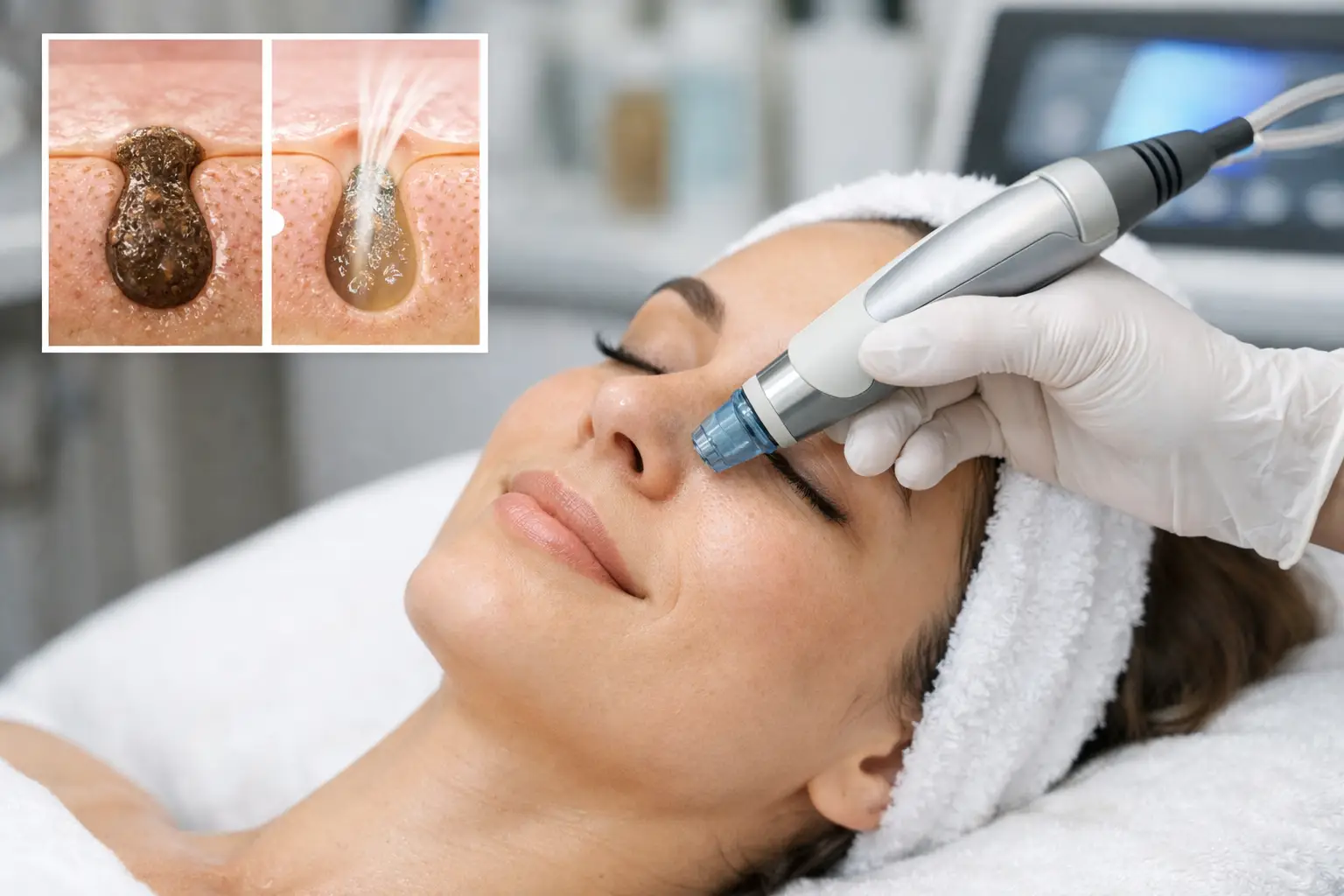
Learn how Hydrafacial cleans clogged pores using exfoliation, suction, and hydration to clear buildup, smooth texture, and refresh skin.
Clogged pores rarely start as a dramatic skin issue. More often, they show up as a rougher skin feel, makeup that sits unevenly, a shine that turns greasy by midday, or those stubborn tiny bumps that never seem to fully clear. If you have been wondering how Hydrafacial cleans clogged pores, the answer lies in a precise, multi-step treatment that clears buildup while keeping the skin calm, balanced, and hydrated.
That balance is exactly why Hydrafacial has become such a sought-after treatment in premium aesthetic clinics. Traditional extractions can leave skin red and irritated. Heavy exfoliation can help one concern while aggravating another. Hydrafacial takes a more refined approach by combining exfoliation, vacuum-based extraction, and targeted serum infusion in one session, which makes it especially appealing for clients who want visible improvement without downtime.
How Hydrafacial cleans clogged pores
A clogged pore forms when oil, dead skin cells, sweat, sunscreen residue, makeup, and environmental debris collect inside the follicle opening. In oilier areas like the nose, chin, and forehead, that buildup can compact and oxidize, which creates blackheads. In other areas, it may stay trapped under the surface and appear as congestion, whiteheads, or a bumpy texture.
Hydrafacial addresses this congestion in stages rather than trying to force the skin into a quick result. First, the treatment removes the outer layer of dull, dead skin cells that can trap debris near the pore opening. Then it loosens hardened sebum and impurities inside the pores using gentle exfoliating solutions. Finally, it uses controlled suction to lift that softened debris away. Once the pores are cleared, hydrating and antioxidant-rich serums are infused back into the skin so it feels clean, not stripped.
This is a key distinction. Pore-clearing treatments often focus only on removal. Hydrafacial is designed to treat what is blocking the pore while also supporting the skin barrier, which is one reason many clients find their skin looks fresher and more refined immediately afterward.
What happens during the treatment
Hydrafacial is often described as a facial, but the technology behind it is what makes the treatment different. It uses a specialized handpiece with vortex technology to cleanse, exfoliate, extract, and infuse. Each step has a specific purpose, and together they create the polished finish many patients notice after one session.
Step 1: Cleansing and exfoliation
The first phase focuses on removing surface impurities and dead skin cells. This matters because pores do not just get clogged from within. A layer of compacted cells on the surface can make pores appear larger and can trap oil beneath them.
By exfoliating the top layer of the skin, Hydrafacial helps open the way for deeper cleansing. The skin feels smoother, and the treatment can work more effectively on congestion that sits lower in the pore.
Step 2: Gentle acid peel
This part often surprises first-time clients. The peel used in Hydrafacial is typically a mild blend, commonly including glycolic and salicylic acids, and it is designed to loosen debris rather than aggressively resurface the skin.
Salicylic acid is especially useful for clogged pores because it is oil-soluble, which means it can move into the pore lining and help break down the mixture of sebum and dead skin. Glycolic acid works more on the surface, helping lift away dull cells and improve texture. Used together in the right concentration, they help soften congestion so extraction is easier and more comfortable.
Step 3: Extraction with vortex suction
This is the step most directly tied to how Hydrafacial cleans clogged pores. Instead of relying on manual squeezing, the device uses controlled suction to remove loosened oil, dead skin, and debris from the pores.
Because the congestion has already been softened, the extraction process tends to feel gentler than traditional methods. For many clients, this means less redness and less post-treatment irritation. It is also a more even process, which is especially helpful in areas with widespread congestion rather than one isolated blemish.
Step 4: Hydration and serum infusion
Once the pores are clear, the treatment infuses the skin with hydrating and nourishing serums. These often include ingredients such as hyaluronic acid, peptides, and antioxidants, depending on the skin concern being addressed.
This step is not just a luxury add-on. When the skin is properly hydrated, it tends to look smoother and calmer, and it is less likely to react as if it has been over-treated. For clients who are prone to both congestion and dehydration, this is where Hydrafacial stands apart from harsher pore-cleaning approaches.
Why clogged pores happen in the first place
Understanding the cause of congestion helps explain why one treatment may work beautifully for one person and only partly for another. Clogged pores are not always a sign of poor cleansing. They can be driven by excess oil production, hormonal shifts, heat and humidity, rich skincare products, inconsistent exfoliation, or simply skin type.
In a climate like Dubai, congestion can become more persistent because sweat, sunscreen, pollution, and oil tend to accumulate quickly. Even clients with polished skincare routines may still notice buildup around the T-zone or jawline. That is why in-clinic treatments can be useful as part of a maintenance plan rather than a one-time fix.
Does Hydrafacial work for blackheads and textured skin?
In many cases, yes. Hydrafacial can be very effective for blackheads, sebaceous filaments, and overall skin congestion. It is also well suited for people who feel their skin looks dull, uneven, or rough even when they are not actively breaking out.
That said, results depend on the type of congestion. Fresh, softer buildup usually responds quickly. Deeply compacted blackheads or acne that is more inflamed may need repeat sessions or a broader treatment plan. If someone has active cystic acne, very sensitive skin, or barrier damage, a skilled provider may adjust the protocol or recommend another approach first.
This is where personalization matters. A medically guided aesthetic clinic can assess whether Hydrafacial is the right first step or whether your skin would benefit more from combining it with acne-focused dermatology care, medical-grade skincare, or a schedule of regular maintenance sessions.
The difference between Hydrafacial and traditional extractions
Manual extractions still have a place in professional skincare, but they can be uncomfortable and sometimes leave visible redness for a day or two. They also depend heavily on technique and can be more reactive for sensitive skin.
Hydrafacial offers a more controlled experience. The exfoliation and peel phase prepare the pores before extraction begins, and the suction mechanism removes debris without as much pressure on the skin. For clients who want a treatment that fits into a busy schedule, this lower-downtime profile is a major advantage.
The trade-off is that Hydrafacial is not always the answer to every type of acne lesion. It excels at generalized congestion, blackheads, oiliness, and texture. More severe acne may require a broader medical treatment plan.
How often should you get Hydrafacial for clogged pores?
If clogged pores are a recurring concern, monthly treatments are often recommended. This timing aligns well with the skin's natural renewal cycle and helps prevent congestion from becoming heavily compacted again.
For some clients, especially those preparing for an event or recovering from a long period of neglected skin maintenance, a more tailored schedule may make sense at the start. Others may maintain results with less frequent sessions if their home care is strong and oil production is relatively balanced.
What matters most is consistency. Pores do not stay clean forever, especially if your skin naturally produces more oil or you live in a hot, humid environment. Think of Hydrafacial as part corrective, part maintenance.
Who is a good candidate?
Hydrafacial suits a wide range of skin types, including clients with mild sensitivity who may not tolerate more aggressive resurfacing well. It can be particularly appealing for busy professionals who want clearer, smoother skin without planning around recovery time.
It is also a strong option for people who feel stuck between two concerns: congestion and dehydration. Many treatments improve one while worsening the other. Hydrafacial is designed to do both - clear the pores and replenish the skin.
At a clinic such as Fit4You Polyclinic, the value is not only in the technology itself but in how the treatment is customized. The right protocol, serum selection, and skin assessment can elevate a standard facial into a more strategic treatment for long-term skin clarity.
The most satisfying thing about Hydrafacial is that it respects the skin while improving it. When pores are cleared without leaving the skin irritated or depleted, the result looks polished, healthy, and believable - which is exactly what modern aesthetic care should deliver.
Interested in this treatment?
Book a free consultation with our specialists at Fit4You Polyclinic Dubai.
Book Free Consultation